Pelagia did not begin with a software specification. It emerged from decades of work by engineers, oceanographers, instrument operators, software developers, and plankton ecologists learning how to observe life in the water column—and how to make sense of the resulting data.
Instrument engineeringCharles Cousin, Cedric Guigand, and Bellamare
Imaging scienceDr. Adam Greer and research collaborators
Operations and softwareThomas Kelly, Hannah Kepner, and Icy Seas
The development timeline
Built, tested, learned, and refined.
No single deployment, instrument, or software release created Pelagia. Each generation solved another part of the problem and revealed the next one.
Early 2000sEngineering
A first deployment makes the problem real.
Charles Cousin's early field deployments established a principle that still shapes the work today: ocean-imaging systems have to be designed around real operations, real vessels, and the people responsible for keeping an instrument working at sea.
2004–2005Engineering
Bellamare and ISIIS take shape.
Bellamare was founded to build practical systems for ocean research. Cedric Guigand invented the ISIIS-DPI technology, while Charles developed the field-facing engineering and long-term partnerships needed to carry instruments from concept through deployment. The first ISIIS system demonstrated that plankton could be imaged in place across fine spatial structure rather than removed from context by conventional sampling.
Adam Greer's documented work with ISIIS includes a 2010 shakedown cruise off San Diego. That early work helped establish in situ imaging as more than a novel instrument: it could resolve plankton distributions, interactions, and environmental structure at scales conventional sampling could not preserve.
2012–2018Science
Fine-scale ecology comes into view.
Adam and his collaborators applied ISIIS to fronts, thin layers, predator–prey interactions, larval-fish habitats, and gelatinous zooplankton communities. This work demonstrated that high-resolution imagery could connect individual organisms to the physical and biological structure around them.
2019–presentScience
A broader generation of plankton imaging.
At the University of Georgia Skidaway Institute of Oceanography, Adam and the ZERO-C Lab have continued developing and applying in situ imaging across diverse field, laboratory, and mesocosm settings. His official CV lists 33 peer-reviewed publications through 2025, many centered on imaging, fine-scale ocean structure, and plankton ecology.
Bellamare, the University of Alaska Fairbanks, and the Northern Gulf of Alaska LTER team brought DPI-3—a Bellamare-built undulating towed vehicle fitted with three ISIIS-DPI plankton cameras and a suite of acoustic and environmental instruments—into sustained transect surveys. The work paired high-volume plankton imagery with vehicle and environmental observations and produced far more data than a science team could inspect manually.
ISIIS-DPI imagery preserves both the organism and its original sampling context.
Thomas Kelly and Hannah Kepner worked across instrument operations, data handling, image processing, classification, and scientific review. Their experience clarified what a durable processing environment has to provide: throughput, visible context, repeatable methods, and traceability from every derived observation back to its source.
2025Convergence
The method becomes modular.
Adam Greer, Charles Cousin, and collaborators published a methods paper describing modular shadowgraph imaging across field and mesocosm applications. The milestone reflects a larger transition: an imaging concept had matured into a flexible family of scientific tools.
Thomas created Pelagia through Icy Seas Co-Laboratory LLC to turn accumulated processing methods into reusable scientific software. Today, Icy Seas and Bellamare combine software, scientific-computing, instrument, and deployment expertise, with guidance from Adam, to carry this history into a transparent platform for high-volume pelagic imagery.
What Pelagia inherits
Lessons carried forward.
Built for deployment
Systems must work under real shipboard constraints and remain understandable to the people operating them.
Designed for scale
Processing must keep pace with sustained acquisition rather than turning every survey into a growing backlog.
Judgment stays central
Automation should expose the imagery and evidence scientists need to evaluate a result—not hide them.
Every result is traceable
Observations should remain connected to source imagery, metadata, processing history, and scientific review.
Pelagia today
The architecture is new. The experience behind it is not.
Pelagia carries this history forward as an open, integrated environment for real-time processing, scientific review, and analysis-ready export. It is designed to keep imagery connected to environmental context, make automated decisions inspectable, and support the people responsible for turning observations into science.
PelagiaView keeps automated detections connected to their original frame and review context.
Help carry the work forward.
Pelagia is built through the same process that shaped the instruments behind it: deploy, learn, refine, and share what works.
Pelagia is designed around a practical oceanographic need: identify plankton and transform high-volume pelagic imagery into consistent, reviewable observations in real time.
From Imagery To Evidence
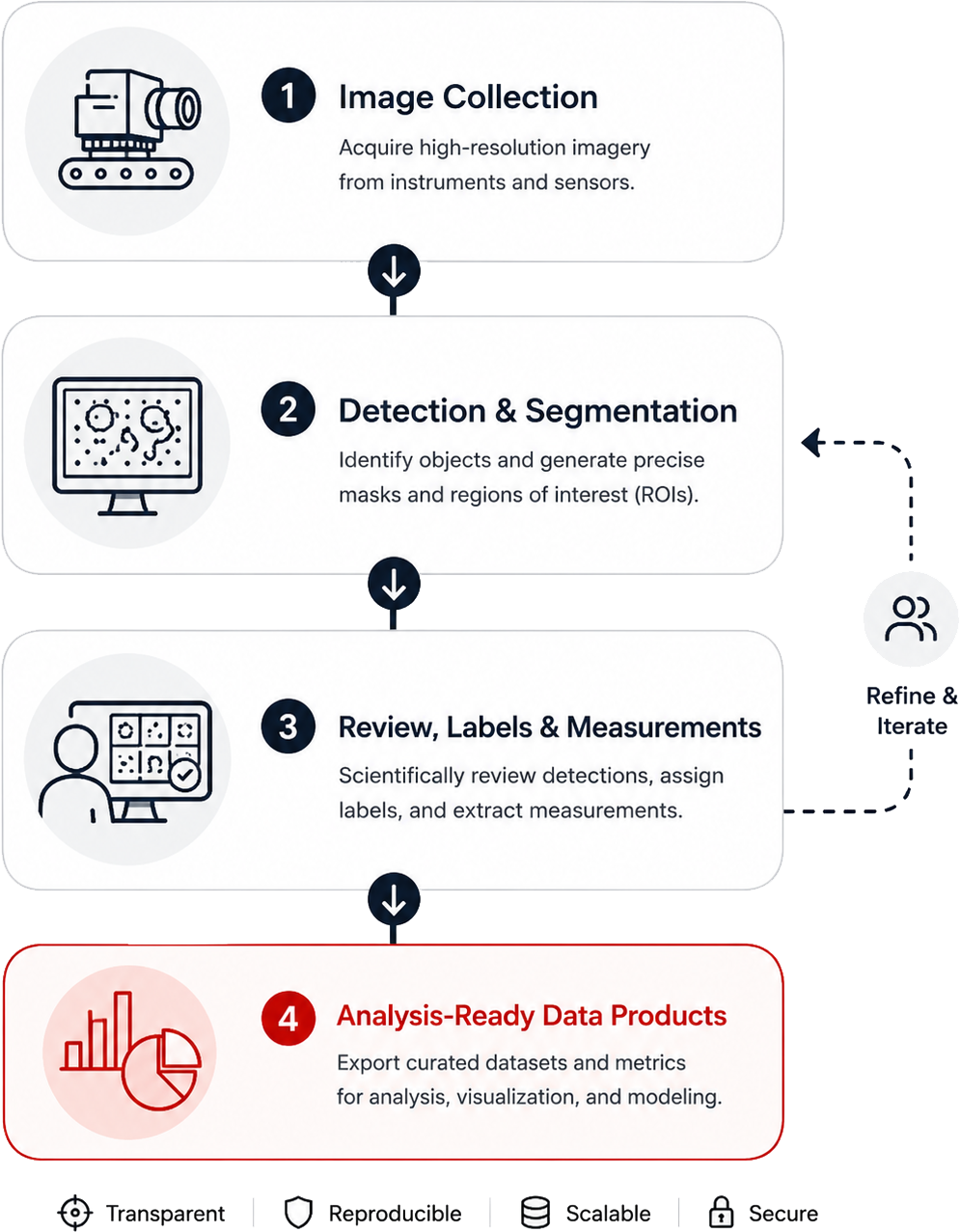
Pelagic imaging programs can generate more visual data than a research team can inspect frame by frame. Pelagia processes that stream as it arrives, identifying plankton and organizing candidate organisms, particles, and other features so they can be compared, measured, reviewed, labeled, and exported.
Human Judgment Stays Central
The goal is not to hide scientific interpretation behind automation. Pelagia keeps imagery, regions of interest, masks, measurements, labels, and review progress visible so scientists can inspect the data products that matter and refine the workflow as the dataset teaches them what to look for.
Built For Iteration
Oceanographic image analysis is rarely a one-pass task. Thresholds, segmentation methods, labels, review criteria, and model outputs evolve as teams learn the instrument, the habitat, and the biological signal. Pelagia supports that iterative loop: explore, process, review, adjust, and export.
Data Science Ready
The outcome is not just a set of images. Pelagia is meant to create structured outputs that can support abundance estimates, distribution analysis, model training, quality control, reporting, and downstream scientific workflows.